
Regenerative PLA+ 1.75mm Filament – Sustainable PLA with Worry Free Plastics® Technology
No se pudo cargar la disponibilidad de retiro
Regenerative PLA+ supports a more circular approach to plastics by designing for what happens after use, not just during it. It's powered by Worry Free Plastics® to attract microbes that transform the material into soil instead of lingering as microplastics.
Print Settings
Print Settings
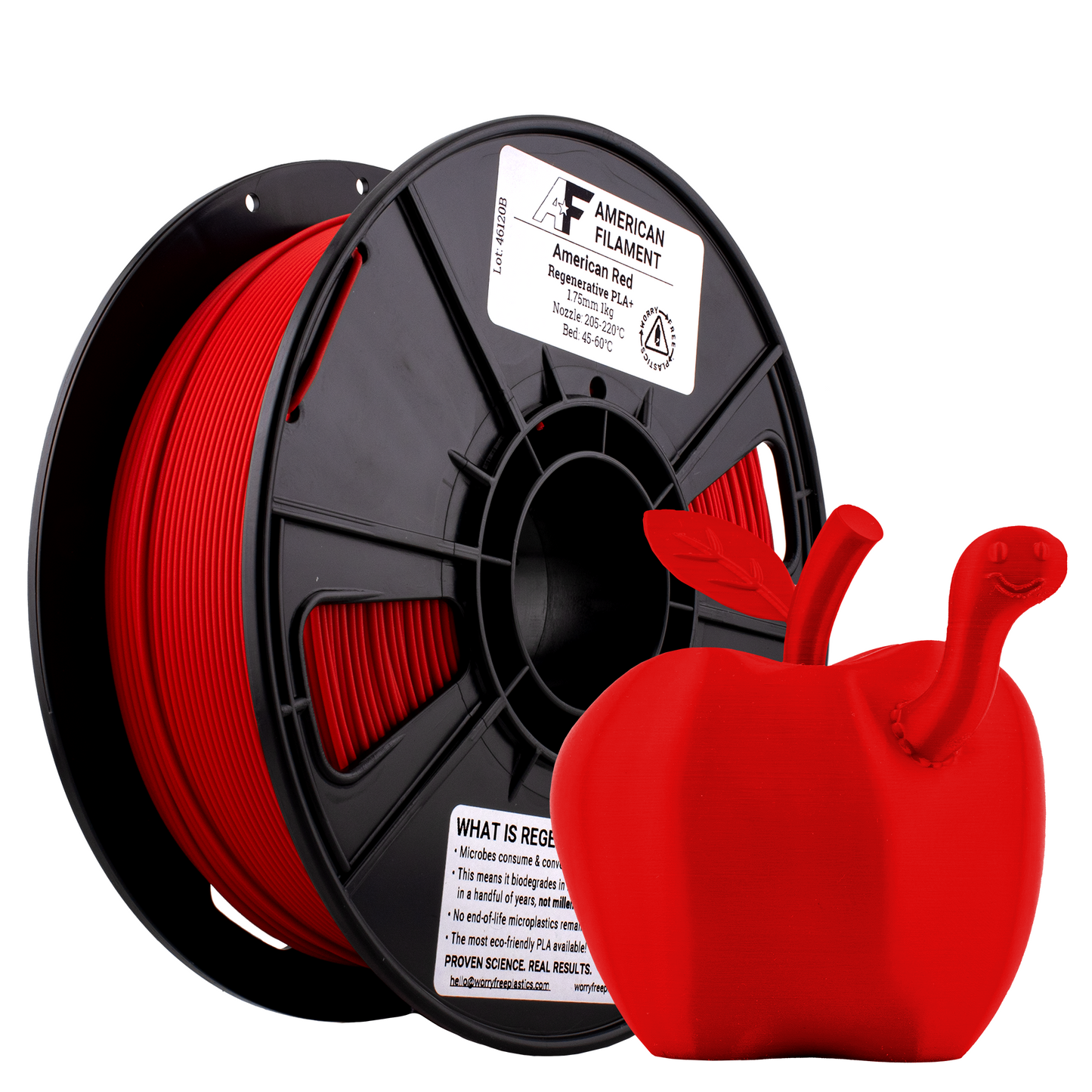
- Nozzle Temperature: 205 - 220°C
- Bed Temperature: 45 - 60°C
1kg Spool Dimensions (AMS-Compatible)
- Filament Weight = 1 kg
- Filament Diameter = 1.75 mm (+/- 0.05 mm)
- Spool Inner Diameter (ID) = 52 mm
- Spool Outer Diameter (OD) = 200 mm
- Spool Width (W) = 67 mm
- Spool Weight = 220 g
Share

WHAT IF YOUR WASTE TRANSFORMED INTO SOIL INSTEAD OF MICROPLASTICS?
Regenerative PLA+ delivers the reliable print performance you expect from PLA+ with a more responsible end-of-life.
Enhanced with Worry Free Plastics® technology, it is designed to support microbial consumption in microbe-rich end-of-life environments, helping the material return to the natural carbon cycle instead of contributing to long-term microplastic persistence.
It remains dormant during normal use and is designed to activate only at end-of-life in environments such as landfills.
IS REGENERATIVE PLA+ BETTER THAN STANDARD PLA+?
Regenerative PLA+ is designed to give you the same reliable printability and durability as standard PLA+, while offering a more responsible end-of-life.
That means you do not have to choose between performance and sustainability. You get the smooth printing experience you expect from PLA+ with material technology designed to reduce long-term plastic persistence after disposal.
- Returns to the natural carbon cycle in years, not centuries - Designed to convert into organic compounds significantly faster than conventional plastics
- Designed to reduce persistent microplastics – Supports microbial consumption instead of long-term plastic fragmentation
- Microbe-assisted conversion – Enables transformation into organic compounds that contribute to soil formation
- Smart activation – Remains dormant during normal use, only activating in landfills or similar environments
ALL THE PERFORMANCE YOU EXPECT FROM PLA+
- Smooth, consistent extrusion
- Strong, dependable layer adhesion
- Low warping and easy printing
- Excellent dimensional accuracy
- Designed for reliable printing on open-frame printers (no enclosure required)
- Compatible with most FDM 3D printers
HOW IT WORKS
DESIGNED TO ATTRACT MICROBES AND TRANSFORM WASTE INTO SOIL-BUILDING COMPOUNDS
Regenerative PLA+ is designed to attract microbes and support their ability to more rapidly "eat" the material at end-of-life. In landfill and similar environments, naturally occurring microorganisms interact with the material and convert it into organic compounds that can contribute to soil formation - helping it return to the natural carbon cycle instead of persisting as long-term microplastics!
THE SCIENCE BEHIND IT
Regenerative PLA+ incorporates an additive system engineered to enable microbial depolymerization under microbe-rich conditions such as those found in landfill environments.
This additive system is designed to promote microbial colonization and, through hydrolysis, help convert polymer chains into lower molecular weight compounds that microorganisms can metabolize. Over time, this process produces organic compounds that can contribute to soil formation, supporting reintegration into the natural carbon cycle.
For a deeper look at the science, visit the Worry Free Plastics Science page.
Learn More About How Regenerative PLA+ Works
Regenerative PLA+ Filament FAQ | Sustainable PLA+ for 3D Printing
FAQ's
What is Regenerative PLA+ filament?
Regenerative PLA+ is an eco-conscious PLA+ filament enhanced with Worry Free Plastics® technology, designed to attract microbes and support their ability to consume the material at end-of-life. This helps reduce long-term plastic waste and microplastic persistence—while still delivering the easy printing and reliable performance you expect from high-quality PLA+.
What makes it different from other “biodegradable” plastics?
Many plastics labeled “biodegradable” can still break down into smaller pieces that remain in the environment. Regenerative PLA+ is designed so microbes can consume the material at end-of-life, helping it return to the natural carbon cycle instead of contributing to long-term microplastic persistence.
Is Regenerative PLA+ better than standard PLA? Why should I choose it?
Regenerative PLA+ delivers the same easy printing, reliability, and surface quality as standard PLA+, while being designed with a more responsible end-of-life. It supports microbial consumption at end-of-life, helping reduce long-term microplastic persistence—making it a simple upgrade with no change in how it prints.
Does it produce microplastics?
Regenerative PLA+ is designed to help prevent long-lasting microplastics by allowing microbes to consume the material at end-of-life, helping it return to the environment faster and more fully.
How long does it take to return to the environment?
Regenerative PLA+ is designed to return to the natural carbon cycle over significantly shorter timeframes than conventional plastics—typically on the scale of years rather than centuries—depending on environmental conditions such as microbial activity, temperature, and moisture.
Isn’t PLA already biodegradable?
PLA is a bio-based plastic that can biodegrade under controlled conditions, such as industrial composting. However, in everyday environments, it may not fully convert. Regenerative PLA+ is designed to support microbial consumption at end-of-life, helping it return to the natural carbon cycle more effectively.
Does it print like normal PLA+?
Yes. Regenerative PLA+ prints just like high-quality PLA+ with:
- Smooth, consistent extrusion
- Strong, dependable layer adhesion
- Low warping and easy printing
- Excellent dimensional accuracy
- Works well in open-frame printers (no enclosure required)
- Compatible with most FDM 3D printers
No special settings are required on most FDM printers—start with the same print settings you always use for PLA+
Will AF Regenerative PLA+ work with my 3D printer?
Yes. Regenerative PLA+ is compatible with most FDM/FFF 3D printers that support PLA filament, including popular brands like Bambu Lab, Prusa, Creality, Anycubic, Elegoo, and FlashForge. It prints using standard PLA settings, so no special hardware or tuning is required.
What settings should I use?
Start with your normal PLA+ settings:
- Nozzle: 205–220°C
- Bed: 45–60°C
- Speed: 50-200 mm/s
Minor tuning may improve surface finish depending on your printer.
Does Regenerative PLA+ change during storage, use, or printing?
No. Regenerative PLA+ behaves the same as standard PLA+ during normal use, storage, and printing. The technology stays dormant and activates only in microbe-rich end-of-life environments, such as landfill conditions.
SAME RELIABLE PERFORMANCE, WITH A MORE RESPONSIBLE MATERIAL—THE CHOICE IS EASY.
Learn More about Regenerative PLA+ and the Circular Economy
Ver todo-
What Is Regenerative PLA+ Filament? Why It’s a ...
Regenerative PLA+ is a next-generation 3D printing filament powered by Worry Free Plastics® technology that is designed to print like high-quality PLA+ while offering a more responsible end-of-life. Learn what...
What Is Regenerative PLA+ Filament? Why It’s a ...
Regenerative PLA+ is a next-generation 3D printing filament powered by Worry Free Plastics® technology that is designed to print like high-quality PLA+ while offering a more responsible end-of-life. Learn what...
-
The Truth About Plastic Recycling - It's Not th...
Most people assume plastic tossed in the recycling bin gets turned into something new. In reality, much of it is landfilled, burned, downcycled, or lost from the system entirely. Here’s...
The Truth About Plastic Recycling - It's Not th...
Most people assume plastic tossed in the recycling bin gets turned into something new. In reality, much of it is landfilled, burned, downcycled, or lost from the system entirely. Here’s...
-
What Is the Circular Economy? A Better Way to T...
The circular economy is a better way to think about materials, waste, and sustainability. Learn how circular economy principles apply to plastics and 3D printing, and why regenerative materials like...
What Is the Circular Economy? A Better Way to T...
The circular economy is a better way to think about materials, waste, and sustainability. Learn how circular economy principles apply to plastics and 3D printing, and why regenerative materials like...
-
What Happens to PLA in a Landfill? Does It Degr...
PLA is often described as a biodegradable plastic, but what actually happens when it ends up in a landfill? Here’s why standard PLA may persist in real-world disposal environments and...
What Happens to PLA in a Landfill? Does It Degr...
PLA is often described as a biodegradable plastic, but what actually happens when it ends up in a landfill? Here’s why standard PLA may persist in real-world disposal environments and...