


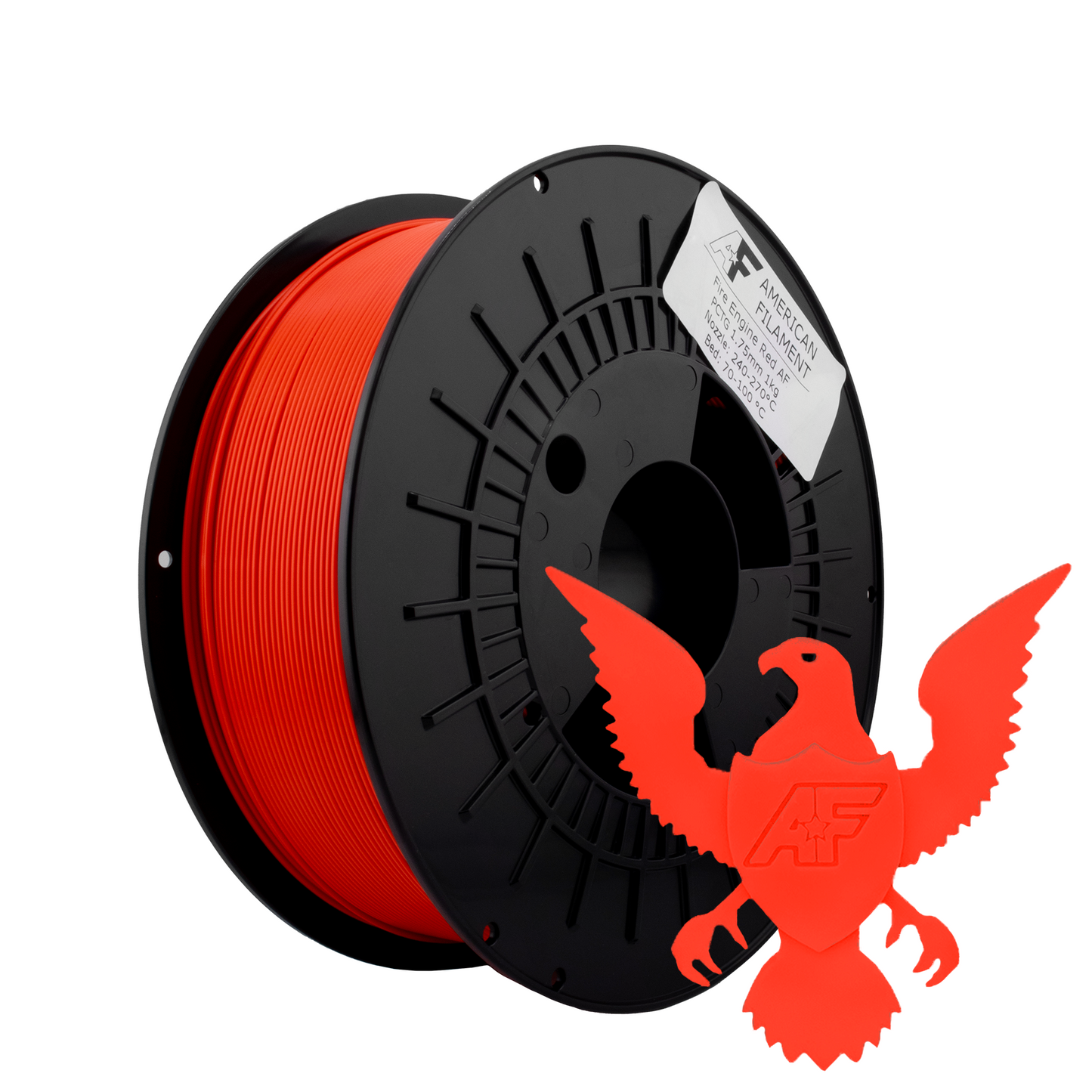
Fire Engine Red AF 1.75mm PCTG Filament
Fire Engine Red AF 1.75mm PCTG Filament
Couldn't load pickup availability
American Filament PCTG is very similar to PETG with several distinct advantages. You could even call it a PETG+! Our PCTG is made with a PET-based copolyester specifically designed for professional grade 3D printing applications where easy processing and high toughness are critical.
Our PCTG is made with a PET-based copolyester specifically designed for professional grade 3D printing applications where easy processing and high toughness are critical.
This material features a unique self-bonding ability providing very high layer-to-layer adhesion; possesses a high melt strength ensuring an even flow during the 3D printing process; is more chemically resistant & stable than PETG, ABS, or ASA (making it suitable for a wide variety of applications); boasts unmatched impact strength & toughness; has lower moisture absorption than PETG (making it more shelf stable); and can be printed reliably without an enclosure.
Unlike PETG, the finish of PCTG can vary between matte and glossy depending upon the temperature and speed settings you choose. Try 240-245°C to get that matte finish!
Key Features:
- Unmatched Strength & Toughness: Higher compressive, tensile, and impact strength than many other PETGs.
- High-Temp: Glass Transition Temperature of 85°C.
- Professional-Grade Performance
- Low Odor
- Does NOT Require Drying Before Use
- Effortless Printing: Even flow rate & wide range of nozzle temperatures.
- Made in the USA: Manufactured with American quality you can trust.
Resources:
- PCTG Technical Data Sheet (TDS)
- PCTG Material Safety Data Sheet (MSDS)
-
PCTG Profile for Bambu Labs Printers
Print Settings
Print Settings
- Nozzle Temperature: 240 - 270°C
- Bed Temperature: 70 - 100°C
- Speed: 60 - 300 mm/s
Nozzle temperature can vary between 240-270°C depending on desired layer to layer adhesion vs part print quality. Higher nozzle temperatures will result in stronger parts, but may cause lower quality and/or increased stringing.
Part cooling can also vary depending on desired layer to layer adhesion vs part print quality. More cooling will result in better overhangs & bridging, but will decrease the ultimate layer to layer adhesion.
DO NOT DRY AT TEMPERATURES OVER 60°C.
1kg Spool Dimensions (AMS-Compatible)
1kg Spool Dimensions (AMS-Compatible)
- Filament Weight = 1 kg
- Filament Diameter = 1.75 mm (+/- 0.05 mm)
- Spool Inner Diameter (ID) = 52 mm
- Spool Outer Diameter (OD) = 200 mm
- Spool Width (W) = 67 mm
- Spool Weight = 220 g
Share


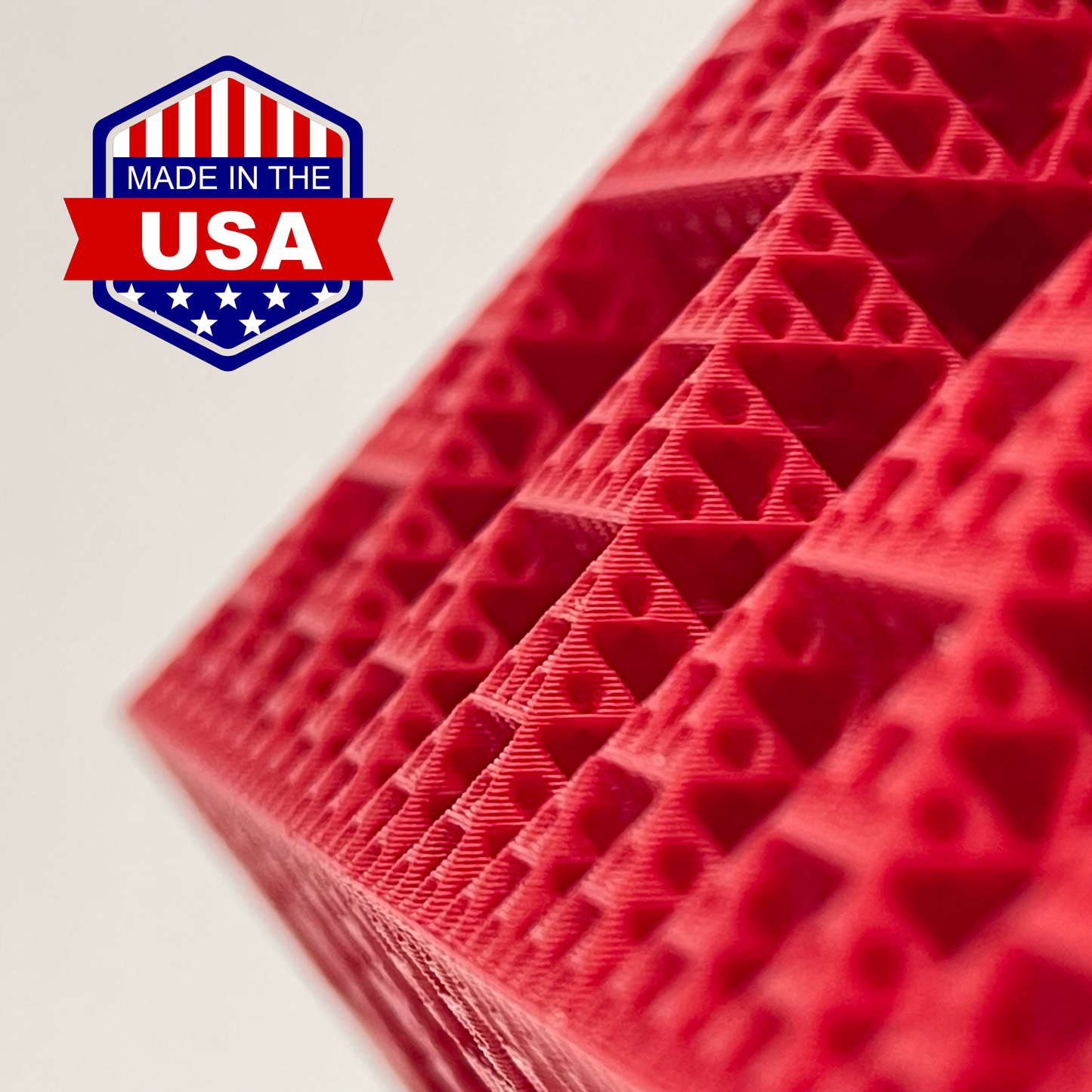

worked out great. no clogs great smooth finish. will order again great looking red wings
Very vibrant colors
We started using their PCTG a few months ago. I first tried it on a Carnival Duck and was blown away. Now that I have started verifying that my temps are 270 and 90 it has only gotten better. So much so that we are now switching to using American Filament PCTG as first choice even over PLA. It may cost more than the Sunlu PLA+ we were using, but it is well worth it. Much better finish and durability without having to spend time in a drier. Tack on UV and chemical resistant, using this filament is a no brainer. So much better than PETG.
Bought this as an alternative to PETG, and was pleasantly surprised. It took a little tuning on my Elegoo Centauri Carbon with Orca Slicer to get it to print correctly, but after small tweaks I was able to get it working. Brims seem to come off easier than PLA and than PETG, and overall the finished product feels more solid. The finish was as expected, not too glossy, not too matte. I'm guessing you can slow down and tweak the temperature to get glossier finishes? For the price though, I am still leaning toward PETG which I can still source cheaper. This will be enticing once we start seeing 3 kg or 5 kg reels at prices that approach name brand PETG pricing (~$18/kg w/ shipping) or even off-brand PETG pricing (~$11/kg w/ shipping). I understand this is a stronger filament and more heat resistant than PETG, but there's currently a hefty premium on PCTG which will hopefully drop once tooling, inventory, demand, and ultimately competetion catch up in the same way that brought PLA and PETG prices to where they are today.
I love creating with this filament, great bed adhesion, fantastic print quality, and vibrant color.